
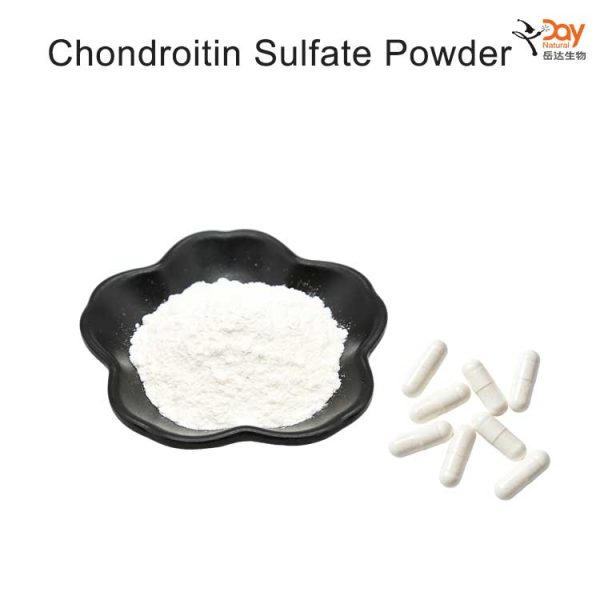
Bulk Supply Purity Food Grade Chondroitin Sulfate
Chondroitin sulfate is widely distributed in the extracellular matrix and on the cell surfaces of animal tissues. It is mainly extracted from cartilage sources such as porcine larynx, nasal bone, trachea, as well as cartilage from cattle, chickens and sharks. After extraction and purification, chondroitin sulfate is obtained and used as a food additive ingredient.
Chondroitin Sulfate (CAS 9007-28-7), as a food additive raw material, has broad application prospects and strong market demand.
Key attributes
| Product Name | Bulk Supply Purity Food Grade Chondroitin Sulfate Food Additives Raw Material CAS 9007-28-7 |
| Other Names | Shark cartilage, bone gelatin sulfate |
| Source | Shark or Chicken |
| Solubility | Easily soluble in water, insoluble in organic solvents such as ethanol, acetone or glacial acetic acid |
| Molecular Formula | C13H21NO15S |
| Appearance | White or Off-white Powder |
| Purity | 100% |
| Test Method | HPLC |
| Grade | Pharmaceutical |
| CAS | 9007-28-7 |
| Application | Food Additives , Medical raw materials |
| Certificate | MUI Halal, SSPY Halal, FDA, KOSHER,VEGAN |
| Packaging | Bottle, Drum, Glass Container, Mason Jar, Plastic Container, Vacuum Packed |
- 25 Years Manufacturer
- Customized Formula
- Premium Quality
- Worldwide Shipping
- Timely Delivery
What is chondroitin sulphate used for?
1. Food additives
Chondroitin sulfate is widely used as a food additive in functional foods and dietary supplements. It helps support immune function and maintain joint health.
2. Medical raw materials
In addition to being a food additive, chondroitin sulfate is also an important pharmaceutical raw material, mainly used to treat arthritis, eye drops, etc., with the effects of pain relief and promoting cartilage regeneration.
3. Other uses
In addition, chondroitin sulfate is applied in cosmetics and wound healing products, providing moisturizing effects and supporting skin repair.
Is chondroitin sulfate the same as glucosamine?
Chondroitin sulfate and glucosamine are not the same substance. They differ in chemical structure, source, and physiological functions.
1. Chondroitin Sulfate
Source: Mainly found in animal connective tissues centered on cartilage, such as the laryngeal bones, nasal bones, trachea and other cartilage tissues of pigs, as well as cartilage of cattle, chickens and sharks.
Chemical properties: It is a mucopolysaccharide extracted from tissues by weak alkali and becomes soluble by digestion of proteases. Together with collagen, it is the main component of the intercellular matrix.
Efficacy: Mainly used to enhance immunity and protect joint health. In terms of joint health, chondroitin sulfate can increase the amount of synovial fluid in the joints, thereby enhancing the cushioning and shock absorption capacity of the joints and reducing the wear of bone joints. In addition, it is also used in the medical field, such as the treatment of arthritis, eye drops, etc.
2. Glucosamine
Source: Although the human body can synthesize glucosamine, the synthesis ability will gradually decrease with age. Therefore, for those who need supplements, it is usually obtained through external intake.
Chemical properties: It is a compound in which one hydroxyl group of glucose is replaced by an amino group. Its full name is D-glucosamine, also known as aminoglucosamine or glucosamine.
Functions:It is used to nourish bones, support cartilage repair, and maintain joint structure. As an essential component of chondrocytes, it helps improve conditions such as knee arthritis and meniscus injuries. It is widely used in dietary supplements and pharmaceutical products.
What foods contain chondroitin sulfate?
Chondroitin sulfate is a nutrient beneficial to joint health. It is mainly present in the extracellular matrix and on cell surfaces of animal tissues, especially in cartilage. The following foods are relatively high in chondroitin sulfate:
1. Cartilage foods
Pork cartilage: Rich in chondroitin sulfate, can be eaten by stewing and other methods.
Beef cartilage: It is also a good source of chondroitin sulfate and is commonly found in soups.
Chicken cartilage: Such as the cartilage part of the chicken wing tip, which is easy to eat.
Fish cartilage: Cartilage of fish such as sharks and cod not only contains chondroitin sulfate, but also rich in other nutrients.
2. Other foods rich in chondroitin
Salmon: Every 100 grams of salmon contains a certain amount of chondroitin, and is also rich in Omega-3 fatty acids and vitamin D, which is also helpful for joint health.
Cod: Similar to salmon, cod also contains more chondroitin and is rich in nutrients such as protein, selenium and vitamin B12.
Pig’s trotters: In addition to being rich in collagen, pig’s trotters also contain a certain amount of chondroitin, which helps protect joint health.
Lobster: As a type of seafood, lobster also contains a high amount of chondroitin, and is rich in protein and Omega-3 fatty acids.
Bone soup: Bone soup is a traditional nourishing food that contains a large amount of nutrients such as protein, collagen and chondroitin, which is beneficial to joint health.
3. Other foods that may contain chondroitin sulfate
Shrimp shell: Contain chondroitin sulfate, though not typically consumed directly.
Fish skin, chicken skin, and cartilage from pigs, cattle and chickens: Also provide chondroitin sulfate to support the body’s nutritional needs.
Reviews
There are no reviews yet.